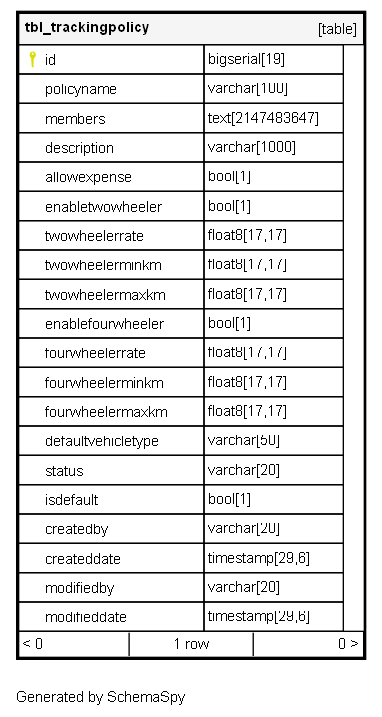
tbl_trackingpolicy

1 rows


Description

Module: HRMS Employee Tracking
Purpose: Defines comprehensive tracking and travel expense policies for employees, including vehicle allowances, rate configurations, and policy membership rules.
Data: Each row represents a complete tracking policy configuration that determines how employee location tracking works and how travel expenses are calculated for different vehicle types.
Process Usage:
- Configures employee tracking parameters and travel expense calculation rules.
- Defines vehicle-specific rate structures with minimum and maximum distance limits.
- Manages policy membership and default policy assignments.
Key Points:
- Integrated tracking and expense management in single policy configuration.
- Flexible vehicle allowance system supporting both two-wheeler and four-wheeler calculations.
- Membership-based policy assignment with default policy support.
Business Impact: Standardizes travel expense calculations, ensures consistent tracking policies across employee groups, and automates vehicle allowance processing.

Columns

Column Type Size Nulls Auto Default Children Parents Comments
id bigserial 19 nextval('tbl_trackingpolicy_id_seq'::regclass)

Primary key
Format: Long (auto-increment)
Used as: Unique identifier for each tracking policy.

policyname varchar 100 null

Format: String
Purpose: Unique name identifying the tracking policy for selection and reference.
Examples: “Field Sales Tracking”, “Executive Travel Policy”, “Standard Office Tracking”, “Remote Work Policy”
UI Usage: Displayed in policy selection dropdowns and assignment interfaces.

members text 2147483647 null

Format: String (JSON or comma-separated)
Purpose: Defines which employees, departments, or groups are eligible for this policy.
Configuration Options:
- Department codes: “SALES,MARKETING”
- Employee groups: “FIELD_STAFF,REMOTE_WORKERS”
- JSON criteria for complex rules
Usage: Automated policy assignment based on employee attributes.

description varchar 1000 null

Format: String
Purpose: Detailed explanation of the policy’s purpose, coverage, and application rules.
Usage: Helps administrators and employees understand policy scope and requirements.

allowexpense bool 1 null

Flag Type: Boolean
True: Policy allows travel expense claims and calculations
False: Policy is for tracking only, no expense processing
Usage: Controls whether employees under this policy can claim travel expenses.

enabletwowheeler bool 1 null

Flag Type: Boolean
True: Two-wheeler vehicle expenses are enabled for this policy
False: Two-wheeler expenses are not allowed
Usage: Controls motorcycle/scooter expense eligibility.

twowheelerrate float8 17,17 null

Format: Double (Currency per kilometer)
Purpose: Reimbursement rate for two-wheeler travel in currency units per km.
Examples: 5.00 (₹5 per km), 2.50 ($2.50 per mile)
Usage: Expense calculation: Total = Distance × Rate.

twowheelerminkm float8 17,17 null

Format: Double (Kilometers)
Purpose: Minimum distance threshold for two-wheeler expense eligibility.
Business Logic: Expenses only calculated for distances ≥ minimum threshold.
Examples: 1.0 (minimum 1 km for reimbursement).

twowheelermaxkm float8 17,17 null

Format: Double (Kilometers)
Purpose: Maximum distance limit for two-wheeler expense claims.
Business Logic: Expenses capped at maximum distance, requires approval beyond limit.
Examples: 100.0 (maximum 100 km per claim).

enablefourwheeler bool 1 null

Flag Type: Boolean
True: Four-wheeler vehicle expenses are enabled for this policy
False: Four-wheeler expenses are not allowed
Usage: Controls car/SUV expense eligibility.

fourwheelerrate float8 17,17 null

Format: Double (Currency per kilometer)
Purpose: Reimbursement rate for four-wheeler travel in currency units per km.
Examples: 12.00 (₹12 per km), 0.65 ($0.65 per mile)
Usage: Expense calculation: Total = Distance × Rate.

fourwheelerminkm float8 17,17 null

Format: Double (Kilometers)
Purpose: Minimum distance threshold for four-wheeler expense eligibility.
Business Logic: Expenses only calculated for distances ≥ minimum threshold.

fourwheelermaxkm float8 17,17 null

Format: Double (Kilometers)
Purpose: Maximum distance limit for four-wheeler expense claims.
Business Logic: Expenses capped at maximum distance, requires approval beyond limit.

defaultvehicletype varchar 50 null

Format: String
Values: “TwoWheeler”, “FourWheeler”
Purpose: Default vehicle type preselected for expense claims under this policy.
Usage: Streamlines expense entry by preselecting the most common vehicle type.

status varchar 20 null

Format: String
Values: ACTIVE, INACTIVE (from TrackingPolicyConstant)
Default: ACTIVE
Purpose: Controls policy availability and usage in the system.
Workflow:
- ACTIVE: Policy can be assigned and used for expense calculations
- INACTIVE: Policy cannot be assigned to new employees

isdefault bool 1 null

Flag Type: Boolean
True: This policy is the default applied to employees without specific assignments
False: Policy requires explicit assignment to employees
Business Logic: Only one policy should be marked as default system-wide.

createdby varchar 20 null
createddate timestamp 29,6 null
modifiedby varchar 20 null
modifieddate timestamp 29,6 null

Indexes

Constraint Name Type Sort Column(s)
tbl_trackingpolicy_pk_tbl_trackingpolicy Primary key Asc id

Relationships